How Mike Gerbino Trusted the Collaborative Process
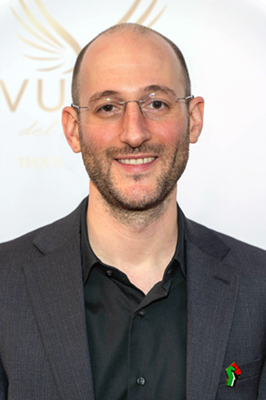
Collider called Mike Gerbino’s screenwriting “unflinching,” which is a huge improvement from what his elementary school teachers would say when they would catch him writing short stories instead of doing his schoolwork. But like any kid with a passion, Mike didn’t let that stop him. By the end of high school, he was shooting his own short films. Today, he works as an editor, screenwriter, and filmmaker, with two produced feature writing credits and an award-winning short film. He understands filmmaking from a variety of angles.
Chatting with InkTip, Mike shared his sound advice for fellow creatives, from being a professional collaborator, to knowing when to market your scripts, and remembering to live beyond the page.
InkTip: Your script Freelance was discovered through InkTip and produced in 2024, but in 2022 you produced and directed a proof-of-concept short film version. How did the process short-to-feature unfold?
Mike: Freelance happened in a somewhat backward way. I had the feature script written already, but I was sick of waiting around for someone to make my stuff so I decided I would adapt it into a short and film it myself. I received some funding from The Film Fund competition and proceeded to shoot the short, all while continuing to send out pitches via InkTip for the feature. While I was in post on the short, a director from Australia named John Balazs responded to my pitch. He loved the feature script and didn’t mind that I had already shot a short version. Six months later, my short film premiered at Dances With Films the very same week we finalized the purchase of the feature script. Less than a year later, John was shooting Freelance out in Melbourne. The projects now live independently of each other but have a special kind of stylistic interplay that I really love.
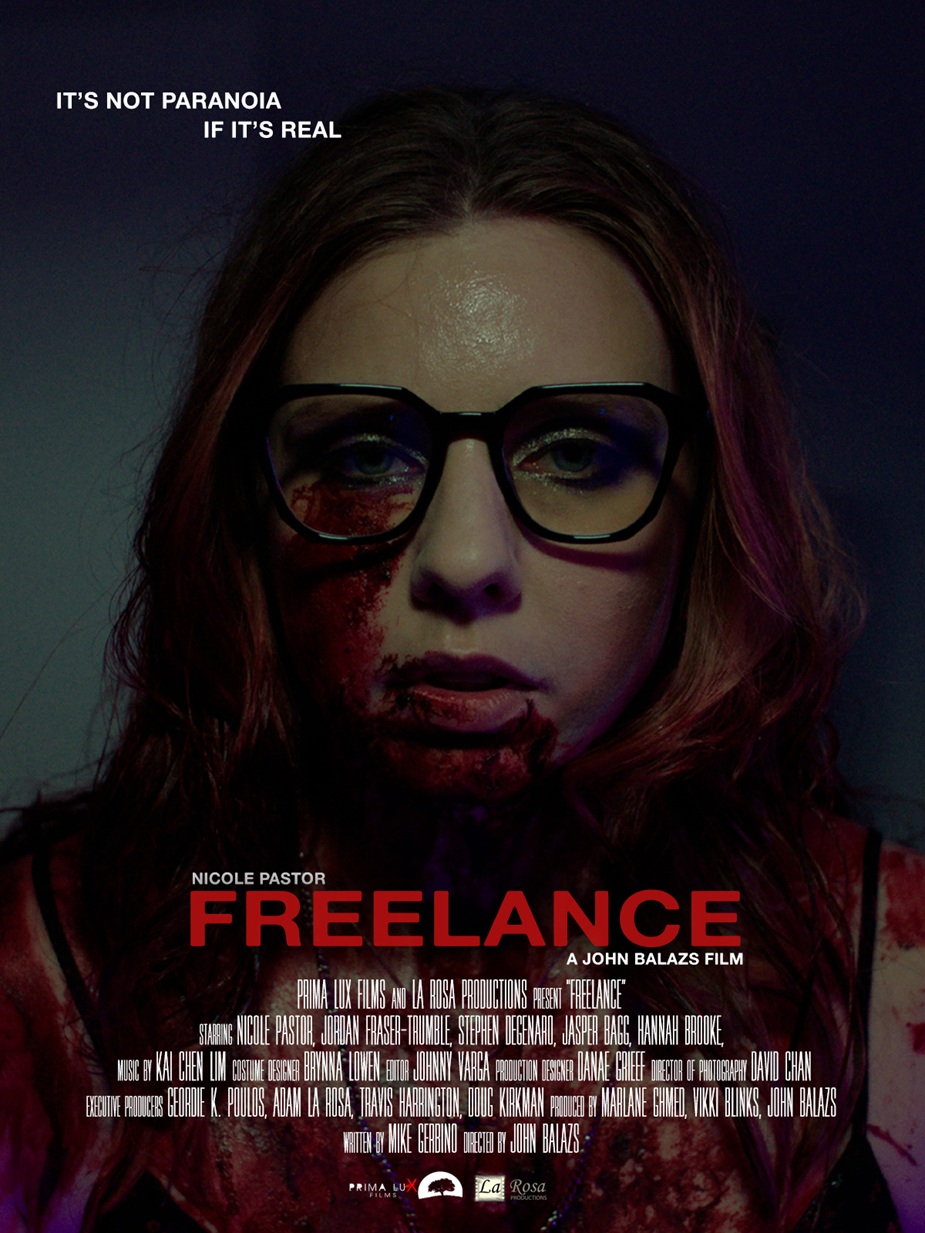 Freelance poster © Prima Lux Films
InkTip: Was it difficult handing over your project and story to another creative?
Mike: I spent so many years dying for someone to produce my work so that I didn’t have to! By the time the opportunity came, I was genuinely thrilled by the prospect of collaborating with a director and seeing what they did. John Balazs has a proven track record of strong films, which helped a lot in the trust department. He also had an obvious respect for my script that I didn’t take lightly, so I never felt there was a danger of the movie turning into something vastly different from what I envisioned. Once you hand over a script, it is no longer your movie. It’s the director’s movie. And, if you’re lucky, you get to feel like it’s OUR movie. I definitely feel that way about Freelance.
InkTip: You’ve had a varied experience in the industry as a writer/director on Dark Justice, as an editor, and filming your own shorts. Was there still something new for you to learn by working with Prima Lux Films on Freelance?
Mike: Dark Justice was a web series which I wrote, directed and produced myself, so it was ultimate control over every aspect with zero resources or room for error. It was a great experience with some really excellent moments, but part of my desire to focus on writing came from learning what my strengths and weaknesses are in that process. Being a professional editor and having a ton of that directing/producing experience allowed me to work with John in a very clear way. We’re filmmakers, we’re editors — we speak the same language. The part of that experience that was brand new to me was letting go. So, I guess the answer is… I learned to let go!
InkTip: When it came to the film, was there something specific you were happy to see on screen?
Mike: There’s so much I love about the film, but when I saw the final act, I nearly jumped out of my seat. There’s a taut, brilliantly directed sequence that really sends the movie hurdling toward the credits, and I was just so happy that it landed. It was better than what I had on the page, while still being true to it. And, of course, when you have performances like the one Nicole Pastor gives through basically every frame of the film, you just feel very lucky as a writer.
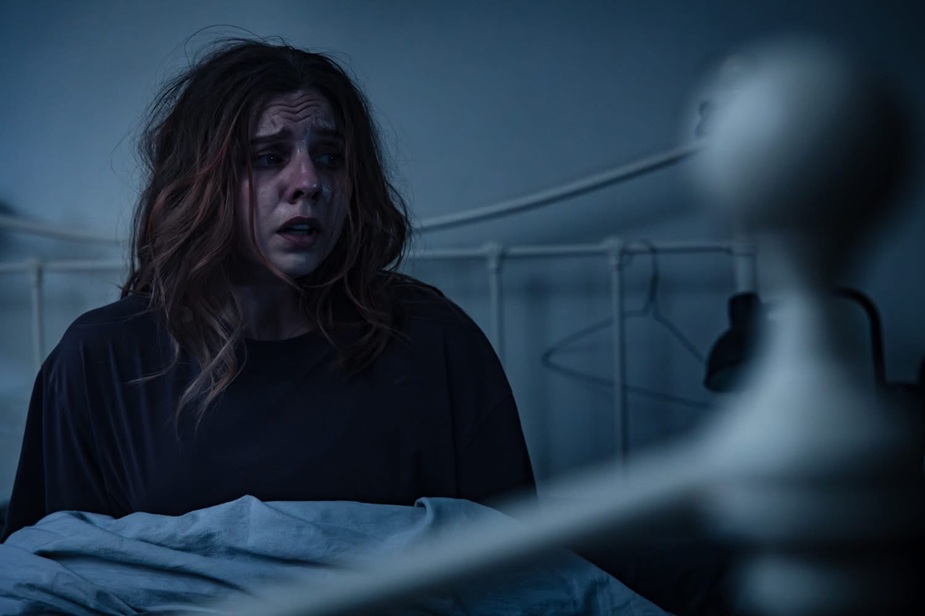 Nicole Pastor in Freelance © Prima Lux Films
InkTip: Collider has called your writing “unflinching” and that Freelance is “exactly what Australian cinema needs.” That’s gotta feel pretty good.
Mike: It feels amazing, though I cannot take credit for giving Australian cinema what it needs. I’m a New Yorker!
InkTip: Both Freelance and The Spotter, your other script that was also found on InkTip and is currently in post, are in the horror/thriller genres. Is that your preferred genre to write in?
Mike: I love horror. I grew up on horror and comedy in equal doses, and that’s probably why those are the spaces I’ve written the most in. I also made a strategic choice several years ago to focus on the horror/thriller genres while trying to break in, as I deeply love writing them, and they happen to be where you can get things made for a lower budget. That strategy obviously paid off, and while I have some exciting comedy and drama scripts ready to go, I don’t plan to give up horror any time soon. The Spotter (which is now called Kaishaku) just had its world premiere at Hollywood Park Film Festival, where it won Best Screenplay! It’s an interesting film in that it undeniably belongs in the horror genre, but it is much more of a drama than I think I even realized as I was writing it. So, I think my horror scripts will always straddle other genres no matter what I do.
InkTip: How did you come up with your story ideas?
Mike: Both Freelance and Kaishaku are about a character being given a chance to make a lot of money in exchange for playing a role in some kind of indirect violence. At the time, I was working jobs where I felt very much like Katie feels in Freelance, being asked to passively work on things I had moral issues with while also knowing that my refusal to do the work wouldn’t necessarily help anyone. I’ve encountered this conflict a few times as a video editor, and I suspect it manifests in other ways through most kinds of jobs. Apparently, my way of processing those feelings of guilt, shame, anger, etc. is by writing really dark movies about them.
InkTip: Do you get writers block?
Mike: I don’t often get writer’s block. I do feel blocked as writer at times, but it’s never for a lack of having ideas. Usually, it’s a matter of mental exhaustion. I write a lot. Every day. And if I sit down to work on a script and nothing comes, I usually just open a different script, and the juices start flowing. If that doesn’t happen, then I go for a walk or get a coffee and see if I can find the headspace to write. I’m trying to get better at listening to my brain and body when I’m being told today just isn’t the day to write. I find I get better results when I walk away and try again later. But the ideas are never very far, and I have so many scripts going at once that I can usually motivate myself to get excited enough to work on something.
InkTip: How do you know your script is ready to market?
Mike: This is the question. Typically, I keep the script very close to my chest as I’m doing the first couple drafts and revisions. At that point, I send it out to get some anonymous coverage. That way, I’m not wasting the time of someone I know and respect with a script that I’m uncertain is even worth reading. The coverage is usually enough to help me decide if this script is working or if I’ve made a terrible mistake. I do many more drafts and eventually put it in the hands of someone whose taste I trust. That’s usually when I know the script is ready for market, and even then, I’ll still toy with it on and off for the rest of my life unless someone buys it.
InkTip: What other projects are you working on?
Mike: So many projects all the time. Aside from my pile of spec scripts, I’m quite excited about a short film I wrote called SPOOL which was directed by Mike Manning at BME Films. It’s a little sci-fi/horror/Christmas drama about a young woman who finds a bottomless hole in her ailing father’s closet. We just won Best Film, Best Writing, and Best Directing at Vancouver Horror Show, which is insane. We’re working on a feature version now, for which I just turned in a new draft. Fingers crossed we’re able to get that moving, but that is the thing I’m really looking forward to at the moment.
InkTip: What advice do you have for writers regarding forming working relationships with producers?
Mike: My advice is to do everything you can to be professional, affable, and adaptable. Coming from an editing background, I know how to work with producers in fairly systematic ways, from outlining and development to addressing notes and feedback. A clarity and consistency in collaboration is really appreciated. You want to be a joy to work with at best, and easy to work with at worst.
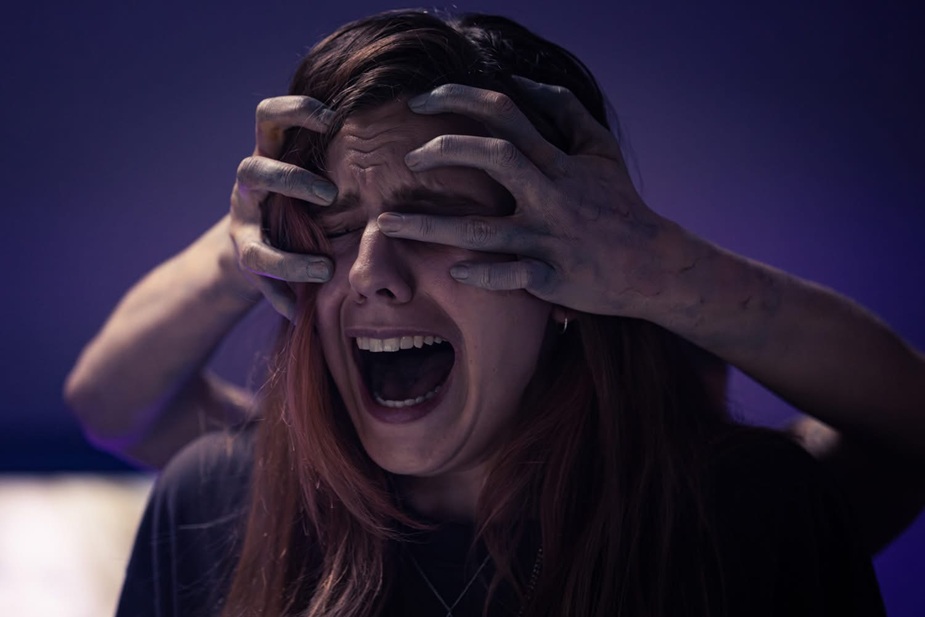 Nicole Pastor in Freelance © Prima Lux Films
InkTip: What’s the one thing you wish you knew earlier in your career?
Mike: Try not to pitch scripts that aren’t “ready,” and NEVER pitch scripts that aren’t finished.
InkTip: What is the best piece of writing advice that you’ve received?
Mike: In his memoir On Writing, Stephen King talks about how he used to have his big fancy writing desk in the middle of his office, as if it were the center of the universe. Then, he moved it to the corner, and now the center of the room is filled with kids' toys and all the things of life. That really stayed with me as someone who is totally obsessive-compulsive as a writer, I could disappear for days working on scripts and be very fulfilled. But living is so much more important, and life is where you’re ultimately going to get your writing ideas anyway. So, as hard as you need to work to make a dent in this industry, don’t forget to push the desk to the side and live some life.
InkTip: What films have influenced you as a writer and how?
Mike: As a millennial screenwriter, I’m obligated to mention Charlie Kaufman. He was the first writer who made me aware of screenwriting, so much so that I think Adaptation is the only film about a screenwriter that we have ever or will ever need. No one else should try. I’m really a writer because of Paddy Chayefsky, Paul Schrader, Spike Lee, The Coen Brothers. These are not people whose scripts are invisible in the final film (which is how most well-written films are and probably should be), but instead their scripts are very alive in everything from the cinematography to the performances, even if it's sometimes to the detriment of the movie. I strive to make my scripts invisible but am undeniably most inspired by the ones that are just screaming at you the entire run-time.
InkTip: What is one film you would love to make every screenwriter watch, and why?
Mike: I wish I had a cool, obscure answer, but I believe Network is the greatest screenplay of all time. Anyone who hasn’t seen it needs to see it yesterday, and anyone who hasn’t seen it recently needs to watch it today.
InkTip: Anything you wish to add?
Mike: I have to really thank InkTip for providing a channel that has led not just to my work being produced, but to connections and relationships that will last beyond any given film.
There are so many services available to “up-and-coming” or “aspiring” screenwriters, and so many of them feel pointless at best and predatory at worst. What I always recognized about InkTip was the practicality of the service – real producers and filmmakers connecting with real writers. It’s as close to a meritocracy as you’re going to get in this industry, and it provides a genuine lane for writers to control their own destiny. It’s the only service where I would regularly receive human responses from folks I was pitching to, even if they didn’t ultimately buy the script. I’d like to think that says something about the quality of my work, but it’s also a notable difference from virtually every other similar service I’ve used.
And I should plug this work! Freelance is now available on VOD and on Tubi. It’s a gritty, Australian horror/thriller directed by John Balazs (if you’ve hit the John Cena film of the same name, you’ve made a wrong turn). My second feature Kaishaku, directed by Harry Locke IV, will likely be released this year, so keep an eye out for that. Finally, my upcoming short SPOOL, directed by Mike Manning, is doing festivals now and will be streaming somewhere in the near future.
A graduate of Northwestern University in radio/TV/film, Chris worked in the film industry as an assosiate producer on reality TV shows before moving into the record industry and eventually landing at InkTip where she runs a plethora of departments. She's written more than 100 articles featuring interviews with producers, screenwriters, actors, and novelists. She spends her free time spoiling her guinea pigs, hiking California, and actively avoiding parking in Hollywood.
Contact InkTip